wastewater treatment pulp bleaching flame retardant smoke suppression
wastewater treatment

ISO 9002


Leading Supplier of Magnesium Oxide and Magnesium Hydroxide Products


We have been asked by quite a number of students preparing research papers to provide some basic information on the properties, manufacture and uses of magnesium oxide. In response to these requests we are pleased to provide the following summary which we hope will not only be educational but interesting as well.

Everything You Ever Wanted to Know About Magnesium Oxide

Physical Properties

Various Grades

Raw Materials

Dead-burned

Mining sources

Hard-burned

Brine sources

Light-burned

Lime source

High purity

MgO Based Compounds

Industrial Uses of MgO

Production of MgO


For general background info on elemental magnesium (Mg), click here.


Physical Properties


Chemical Formula

MgO

Physical State

solid

Molecular Weight

40.31 g/mol

Color

white

Melting Point

2827 ±30°C

Density

3.58 g/cm3


Raw materials needed to produce Magnesium Oxide:

Mineral deposit of magnesite


The majority of magnesium oxide produced today is obtained from the processing of naturally occurring minerals such as magnesite (magnesium carbonate), magnesium chloride rich brine, and seawater.

Large mineral deposits of magnesite are located in Austria, Brazil, Canada, China, the Commonwealth of Independent States (CIS), former Czechoslovakia, Greece, Turkey, North Korea, former Yugoslavia, and the U.S.

When heated from 700°C to 1000°C, magnesium carbonate thermally decomposes to produce magnesium oxide and carbon dioxide:

MgCO3 --heat-->MgO + CO 2(gas)

While mining is one source, another important source of magnesium oxide is obtained from processing seawater and underground deposits of brine which contain magnesium chloride. The remainder of this summary will follow the extraction and processing of magnesium oxide from a typical brine source. The process for extraction from seawater would follow basically the same route, differing only in the concentration of magnesium in seawater.


Deposits of brine, located approximately 2,500 feet below ground, are used in Martin Marietta's process as one source of magnesium.

Brine is essentially a saturated salt solution which, in this case, contains magnesium chloride, calcium chloride and water. Since the concentration of magnesium in this brine source is around 9%, it takes about 2.5 gallons of brine to produce just one pound of magnesium oxide.


Dolomitic Limestone quarry


In order to extract magnesium from brine, another ingredient is needed. Typically this ingredient is lime or calcium oxide (CaO) which is obtained from a mineral source such as dolomitic limestone (CaMg(CO3) 2 ).   When heated to high temperatures the carbon dioxide is driven off leaving calcined dolime:

CaMg(CO 3) 2 --heat--> (CaO·MgO) + 2CO 2(gas)

Calcined dolime also provides another source of magnesium.


Production of Magnesium Oxide:

First, naturally occurring brine is mixed with both calcined dolime and water to produce an aqueous suspension containing magnesium hydroxide and calcium chloride:

CaCl2+MgCl2+H2O

+

(CaO·MgO)

+

2H2O

--->

2Mg(OH)2

+

2CaCl2

+

H2O

brine


calcined dolime


water


magnesium
hydroxide


calcium chloride


water

The magnesium hydroxide and calcium chloride produced from this reaction exist together but in two distinct physical states: magnesium hydroxide is formed as solid particles while the calcium chloride is dissolved in the liquid or watery phase. An aqueous suspension containing solid particles is also referred to as a slurry.


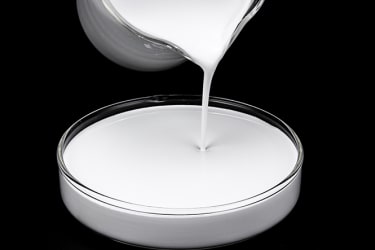
Gravity is used to separate the solids from the liquid in the aqueous suspension since magnesium hydroxide is heavier than water. If you look at a bottle of milk of magnesia, which you probably have in your bathroom medicine chest, you'll see this separation clearly.

Milk of magnesia is another name for magnesium hydroxide. In the photo at left, the freshly made magnesium hydroxide slurry (white) is pumped over to another holding tank and allowed to settle.

The blue color indicates the watery layer containing dissolved magnesium chloride that has formed above the settled magnesium hydroxide particles.


The bottom solids are then filtered to remove any remaining water and given a series of water washes to remove chlorides from the material. This results in a damp filter cake which can be seen dropping off the lower roller of the press (at left) about waist high to the operator. The washed filter cake is finally directed to a source of heat, such as a rotary kiln shown in the photo below, where it is thermally decomposed (calcined) to produce magnesium oxide:

2Mg(OH) 2 --heat--> 2MgO + 2H2O(steam)


Rotary kiln pictured in foreground


Several types of kilns can be used in the calcination step. Calcination not only converts magnesium hydroxide to magnesium oxide, but is also the most important step for determining how the final product will be used.


Three basic types or grades of "burned" magnesium oxide can be obtained from the calcination step with the differences between each grade related to the degree of reactivity remaining after being exposed to a range of extremely high temperatures.


Different Grades of Magnesium Oxide:

The original or "parent" magnesium hydroxide particle is usually a large and loosely bonded particle. Exposure to thermal degradation causes this particle to alter its structure so that the surface pores are slowly filled in while the particle edges become more rounded.


Thermal alteration dramatically affects the reactivity of magnesium oxide since less surface area and pores are available for reaction with other compounds. This change in particle structure is demonstrated in the photographs below.


Dead burned magnesium oxide

Temperatures used when calcining to produce refractory grade magnesia will range between 1500°C - 2000°C and the magnesium oxide is referred to as "dead-burned" since most, if not all, of the reactivity has been eliminated. Refractory grade MgO is used extensively in steel production to serve as both protective and replaceable linings for equipment used to handle molten steel.


10,000 X (surface area:
<0.1 m 2 /gr)


Hard burned magnesium oxide

A second type of magnesium oxide produced from calcining at temperatures ranging from 1000°C - 1500°C is termed "hard-burned".

Due to it's narrow range of reactivity, this grade is typically used in applications where slow degradation or chemical reactivity is required such as with animal feeds and fertilizers.


5,000 X (surface area:
0.1 - 1.0 m 2 /gr)


Light burned magnesium oxide

The third grade of MgO is produced by calcining at temperatures ranging from 700°C - 1000°C and is termed "light-burn" or "caustic" magnesia. Due to the material's wide reactivity range, industrial applications are quite varied and include plastics, rubber, paper and pulp processing, steel boiler additives, adhesives, and acid neutralization to name just a few.


5,000 X (surface area:
1.0 - 250 m 2 /gr)


High purity magnesium oxide

Due to increases of significantly cheaper foreign sources of magnesium oxide and a widely fluctuating steel market (the biggest user of refractory grade MgO), the focus of major magnesium oxide producers in the United States has turned to improved quality rather than supplying commodity quantities. In order to meet the specialized needs of customers, magnesium oxide is further refined and purified. Usually the magnesium oxide is rehydrated (mixed back with water) to form magnesium hydroxide:

2MgO + 2H 2O ----> 2Mg(OH) 2 (slurry)

The slurry form of magnesium hydroxide allows for easier addition of other elements or compounds (in either gaseous or liquid form) to remove contaminants such as calcium, sulfur, and any excess chlorides that may have remained in the original reaction and thereby increases the purity of the product.

Using relatively simple chemistry it is also possible to add certain ingredients to magnesium oxide to generate a broad range of new magnesium based compounds. As in the high purity magnesium oxide process, magnesium hydroxide slurry is a convenient medium for these additions. Examples of typical reactions include:


slurry reactants

slurry + additive --->

end product + water

2MgO + 2H2O --->
(mag oxide + water)

2Mg(OH)2 + 4HNO3 --->
(mag hydroxide + nitric acid)

2Mg(NO3)2 + 4H2O
(mag nitrate + water)

2MgO + 2H2O --->
(mag oxide + water)

2Mg(OH)2 + 2H2SO4 --->
(mag hydroxide + sulfuric acid)

2MgSO4 + 4H2O
(mag sulfate + water)

2MgO + 2H2O --->
(mag oxide + water)

2Mg(OH)2 + 2CO2(gas) --->
(mag hydroxide + carbon dioxide)

2MgCO3 + 2H2O
(mag carbonate + water)


INDUSTRIAL USES OF MAGNESIUM OXIDE:

Abrasives

As a binder in grinding wheels

Animal feed supplement

Source of magnesium ions for chickens, cattle and other animals

Boiler (oil-fired) additives

Raises melting point of ash generated to produce a friable material that is easily removed; reduced corrosion of steel pipes holding steam as well as sulfur emissions into the environment

Boiler feedwater treatment

Reduces iron, silica and solids

Chemicals

Starting point for the production of other magnesium salts such as sulfate and nitrate

Coatings

Pigment extender in paint and varnish

Construction

Basic ingredient of oxychloride cements used for flooring, wallboard, fiber board, and tile

Electrical

Semi-conductors; heating elements insulating filler between wire and outer sheath

Fertilizers

Source of essential magnesium for plant nutrition

Foundries

Catalyst and water acceptor in shell molding

Glass manufacture

Ingredient for specialty, scientific and decorative glassware and fiberglass

Insulation

Light, flexible mats for insulating pipes

Lubricating oils

Additive to neutralize acids

Pharmaceuticals

Special grades of magnesium hydroxide, oxide and carbonate are used in antacids, cosmetics, toothpaste, and ointments

Plastics manufacture

Filler, acid acceptor, thickener catalyst and pigment extender

Refractory and ceramics

Basic ingredient in product formulations for the steel industry

Rubber compounding

Filler, acid acceptor, anti-scorch ingredient, curing aid, pigment

Steel industry

Annealing process; coating for grain-oriented silicon steel used in electrical transformers

Sugar refining

Reduces scale build-up when used in juice clarification and precipitation

Sulfite wood pulping

Source of base for cooking liquors

Uranium, gallium and boron processing

Precipitation initiator by acid neutralization

Wastewater treatment

Acid stream neutralizer; precipitates heavy metals


While there are many factors to be considered in the production of magnesium oxide, this summary presents just a general overview of the entire process. To obtain more information concerning the production of magnesium oxide, please visit the U.S. Geological Survey - Minerals Information page.  Another excellent resource can be found on the National Toxicology Program's website.   Hopefully, this overview helps demonstrate the versatility and value of magnesium oxide in the world of industry today.

Martin Marietta Magnesia Specialties, LLC
8140 Corporate Drive, Suite 220
Baltimore, MD USA 21236
Phone: 800-648-7400 or 410-780-5500
Fax: 410-780-5777                                                
E-mail Us

© 2008 Martin Marietta Materials.
All rights reserved.

Martin Marietta Magnesia Specialties