Just for Students
Martin Marietta Production of Magnesium Hydroxide and Magnesium Oxide

First, naturally occurring brine is mixed with both calcined dolime and water to produce an aqueous suspension containing magnesium hydroxide and calcium chloride:

CaCl2+MgCl2+H2O

+

(CaO·MgO)

+

2H2O

--->

2Mg(OH)2

+

2CaCl2

+

H2O

brine


calcined dolime


water


magnesium
hydroxide


calcium chloride


water

The magnesium hydroxide and calcium chloride produced from this reaction exist together but in two distinct physical states: magnesium hydroxide is formed as solid particles while the calcium chloride is dissolved in the liquid or watery phase. An aqueous suspension containing solid particles is also referred to as a slurry.

Gravity is used to separate the solids from the liquid in the aqueous suspension since magnesium hydroxide is heavier than water. If you look at a bottle of milk of magnesia, which you probably have in your bathroom medicine chest, you'll see this separation clearly.

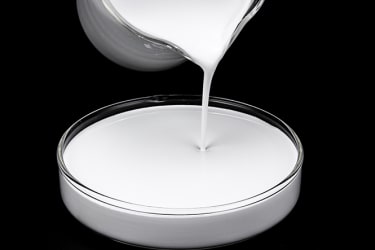
Milk of magnesia is another name for magnesium hydroxide. In the photo at left, the freshly made magnesium hydroxide slurry (white) is pumped over to another holding tank and allowed to settle.

The blue color indicates the watery layer containing dissolved magnesium chloride that has formed above the settled magnesium hydroxide particles.

The bottom solids are then filtered to remove any remaining water and given a series of water washes to remove chlorides from the material. This results in a damp filter cake which can be seen dropping off the lower roller of the press (at left) about waist high to the operator.

The washed filter cake is finally directed to a source of heat, such as a rotary kiln shown in the photo below, where it is thermally decomposed (calcined) to produce magnesium oxide:

2Mg(OH) 2 --heat--> 2MgO + 2H2O(steam)

Several types of kilns can be used in the calcination step. Calcination not only converts magnesium hydroxide to magnesium oxide, but is also the most important step for determining how the final product will be used.

Next: Sources of MgO